One of the biggest mistakes that companies make with their digital marketing efforts is siloing their activities so various campaigns, channels, and strategies operate as singular entities rather than holistically. This hurts your brand’s consistency, makes it more difficult for consumers to find you, and can even create more work for your organization in the long run.
When this happens with your SEO and pay-per-click (PPC) campaigns, you can wind up wasting time and money on ad spend and content production.
So, what’s the better way to go about it? Make your organic and paid search strategies work together.
Running both channels as one program is often called holistic search. In a holistic search strategy, paid and organic teams share keyword data, plan budget together and report against common goals, so each channel covers the queries the other can’t win efficiently instead of competing for the same clicks.
SEO vs. paid search
Both SEO and paid search have the power to elevate brand awareness and bring more traffic to your page. Their main differences are:
- You don’t have to pay every time someone clicks your organic content, but you do pay for clicks with PPC - this can be expensive.
- PPC ads are housed at the top of the search results page, while SEO content can appear in rich snippets or regular search results.
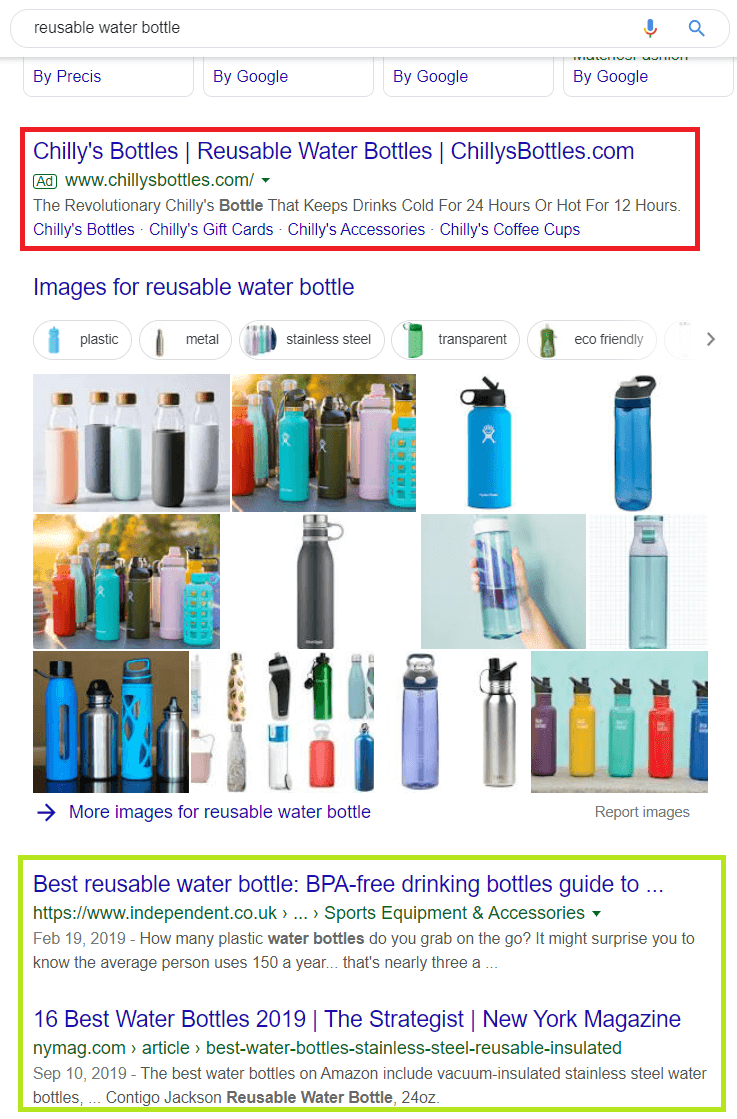
The image below shows an Ad, accompanied by the Google Ad logo, at the top of the screen. The two results underneath the image results are SEO content from authoritative websites.
Paid search
Google says it now handles more than 5 trillion searches a year, and on many of them, especially commercial ones, PPC ads sit at the top of the page. Many companies see that paid search gets them the top spot quickly for their chosen keywords and automatically assume that’s the more beneficial strategy.
However, there’s more to the story. Most clicks still go to the organic results. An analysis of Similarweb data by Aleyda Solis found that in four U.S. product categories in January 2026, organic listings took between 50% and 84% of clicks, while text ads took 13% to 16%. The ads’ share is growing quickly, but what you gain in brand visibility and targeting capabilities, you possibly pay for in overall traffic, and it’s not a cheap loss.
Paid search also gets more expensive on its own. Nate Turner, CEO of the content agency Ten Speed, points out that cost per click rises every year — by roughly 10% to 18%, depending on the industry — so the same budget buys fewer clicks each year. Organic content works the other way. As long as it’s maintained, a page that earns its rankings keeps bringing in traffic without a per-click charge, which makes it an asset that gains value over time while paid spend loses it.
SEO
SEO, meanwhile, doesn’t require you to pay when users click your link, but that doesn’t mean it’s free. Getting a featured snippet or landing a spot on the first page of results requires a strong foundation of good technical SEO, page and domain authority, and an investment in content research and creation. Particularly for smaller or newer businesses, the results are unlikely to be immediate, and for highly competitive keywords, you may be outgunned if relying on organic search alone.
Organic rankings also need upkeep. Content loses ground over time, and Turner’s decay math shows why that matters: if your organic traffic drops 10% a month, your team has to do a lot of work just to stand still before any of it shows up as growth. He separates two causes. External competition is when someone else publishes a better page than yours. Internal competition is self-inflicted: too many overlapping pages that send search engines confusing signals. Budgeting time to keep existing content fresh is part of the real cost of SEO.
To get the most visibility — and traffic — for your website, it’s wise to invest in both PPC and SEO and to ensure both strategies are working in tandem. Let’s learn how.
How to integrate your organic and paid search approach
Consider Eastbay, a sports apparel retailer. When you search “buy basketball shoes,” they show up as the first paid result, as well as the second (and third) organic result.
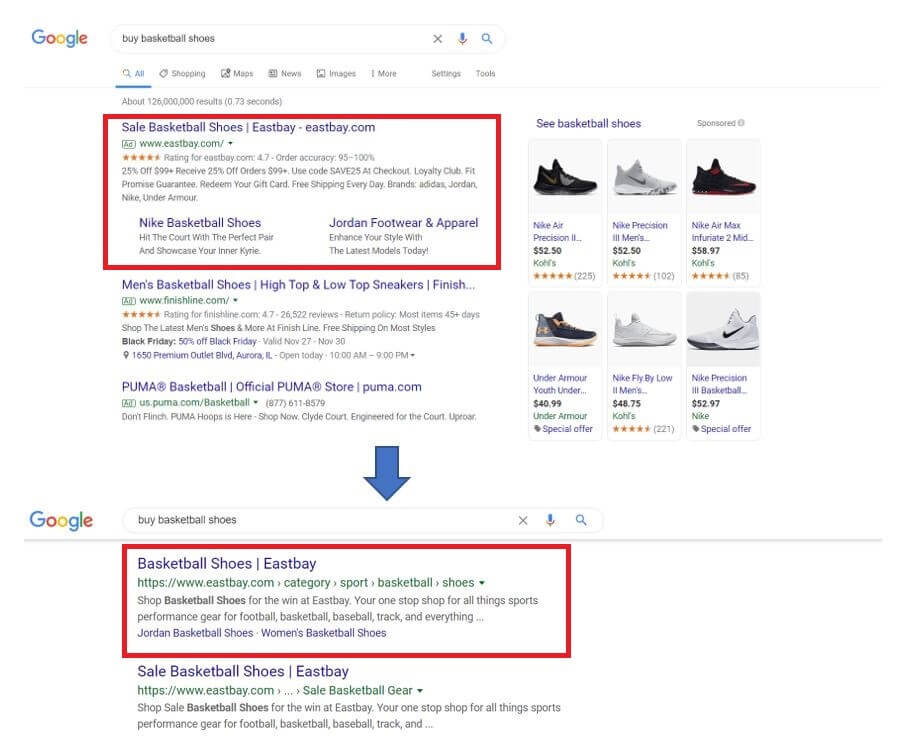
By combining their paid search and SEO strategies instead of just relying on one or the other, Eastbay increases their exposure for a crucial keyword. They also increase their traffic, since many of those people who skip over the PPC ads on the top of the page are going to end up clicking on Eastbay’s organic links. Below we share four ways to align your SEO and PPC strategies and boost your search traffic and conversions.
1. Map your marketing funnel to search intent
Before you can discern which keywords are best for PPC and which are better for SEO, it's important to take some time to identify the kinds of searches people are likely to conduct at each stage of the funnel.
Try this: Look at your marketing funnel and map out search intent and keyword ideas. What kinds of searches would your ideal customers conduct in each stage? If you’re an accounting firm, here’s what your notes might look like:
| Funnel stage | Ideal customer's search intent |
|---|---|
| Top funnel |
|
| Middle funnel |
|
| Lower funnel |
|
Start close to the product. Once your map is done, resist the urge to begin at the top. Turner’s advice: “We love to start close to product, and then build from there.” Lower-funnel content, such as comparison pages, solution pages, and answers to the questions people ask when they’re already evaluating a purchase, is where organic rankings pay off fastest and where paid clicks convert best, because the searcher’s intent matches the page’s purpose. Once that high-intent core is in place, build outward into the middle- and top-funnel topics that widen your reach.
2. Choose the right keywords and phrases
Next, explore keyword ideas for each section of the funnel. Continuing with the example above, here are a few:
| Funnel stage | Keyword ideas |
|---|---|
| Top funnel |
|
| Middle funnel |
|
| Lower funnel |
|
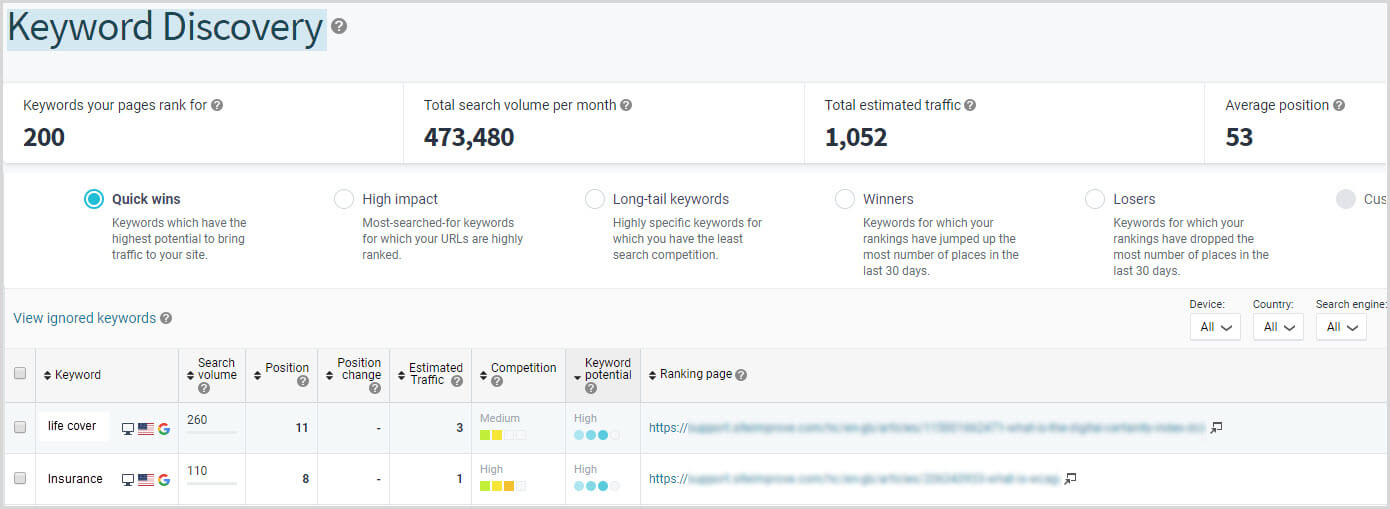
Use a search engine marketing tool. While you can brainstorm keywords using Google, you’ll have the most success discovering the best keywords with a search engine marketing tool, like Siteimprove Keyword Discovery, that can show you key data like search volume, competitiveness, and estimated cost per click. Not only will this help with budget planning for your paid ads, but it’ll help you discover search you might not have considered — meaning your organic content can fill that gap.
When choosing your final target keywords, here are a few things to keep in mind:
Aim for the right traffic, not the most traffic. The more clicks you get from your PPC ad, the more you’ll have to pay — so it makes sense to target only those users who are ready to make a purchase. An easy way to hone in on the audience you really want is to Google your target keyphrase and study the results. Are the organic results similar to your business and niche? If not, experiment with new wording to find keyphrases that are a closer match to your users’ language.
Include long-tail variations. When you select long-tail keywords, you’re narrowing down users to only those who very closely match your target audience. Ideal long-tail keywords for PPC campaigns often include words like “buy,” “cheap,” “order,” and “best.”
Target local keywords. Targeting local keywords for your PPC campaign can give small businesses a major boost in visibility — especially if they already have an active Google Business Profile.
Pair SEO with PPC for a stable reputation. While PPC can help you score conversions fast, users are more likely to trust organic content over paid ads. If you’re ever faced with a public relations issue, your hard-earned organic content will help uphold your positive reputation.
3. Double up existing data
If you’ve been running PPC and SEO campaigns already, use the data you have to inform your future strategy. For example, if you have a keyphrase that’s doing really well in a PPC campaign, use that same keyphrase for SEO and see if you can dominate the organic results as well.
The data runs both ways. Turner describes a halo effect between the two channels: paid results can show you which page deserves to rank for a query or group of queries, so your organic investment goes to a tested answer instead of a guess. And people who first find you through an ad often come back later through a branded organic search, which standard channel reports rarely credit to the ad.
The shared view also stops you paying for clicks you’d earn anyway. Branded keywords often show a high click-through and conversion rate in PPC reports, but if you already rank first organically for the same terms, some of those paid clicks would have come through the organic listing. Test lowering branded bids where you hold the top organic position and check whether total clicks from search hold steady. The same logic works for new terms: fund paid coverage while you build the organic page, then scale paid back as the ranking improves. It also works in reverse when an algorithm update knocks a key page down the rankings, because paid ads can hold your visibility while you fix it.
This is especially useful for growing brand awareness and trust, since users will see your brand twice in search results. Even if they’re not the type to click ads, just the presence of your brand name at the top of SERPs will keep your business top-of-mind.
4. Harness the power of PPC remarketing
Remarketing is one of the best ways to use PPC to amplify your SEO efforts. With this strategy, you use paid search to re-engage with people who have shown initial interest in your product or service through organic search. These leads are further along in their journey than general searchers. Simply put, they’re likely to be a better investment.
That initial touchpoint is one of the key purposes of all search strategies. Once you get it though, you must be even more strategic about facilitating future engagement. By building on your SEO with PPC remarketing, you bolster your positioning and stay top-of-mind when and where it really counts. You also get the opportunity to put forth more personalized, more targeted paid search ads.
Key takeaway: When you integrate your organic and paid search efforts into one holistic search strategy, rather than running them in isolation, you get improved outcomes for less money, and more powerful insights to help guide your future search marketing efforts.