For years, the advice on last-click attribution was simple: switch to something else. Google Ads offered half a dozen models, and most of them spread credit further up the funnel than last click ever would. That advice has expired. In 2023, Google retired first click, linear, time decay and position-based attribution from Google Ads and Google Analytics 4 (GA4). Two models remain for most conversion actions: last click and data-driven.
The question has narrowed, and it has become sharper. Last click is still available, still widely used, and still hides most of the customer journey. For an enterprise running paid search, paid social, display, email and organic channels through different teams and often different agencies, choosing between last click and data-driven isn’t an account setting. It’s a measurement decision that every budget conversation inherits.
What is last-click attribution?
Last-click attribution gives 100% of the credit for a conversion to the final click before it. In Google Ads, that means the last-clicked ad and its keyword. Every earlier interaction on the path receives nothing.
So how does this work in practice?
Let’s say you’re running ads for the keyword ‘sport pants’. A user will normally run several searches before buying. The sequence may look something like this:
‘Best sport pants for running outside for men’ > ‘Under Armour training pants’ > ‘Under Armour Challenger III training trousers’ > Purchase.
This is the classic search chain. The user starts with a broad term and narrows it until they know exactly what they want, at which point they buy.
Under last click, 100% of the credit goes to the ad shown for the final query, ‘Under Armour Challenger III training trousers’. The two searches that introduced the product and narrowed the choice get no credit at all.
Data-driven attribution is now the default model for most conversion actions in Google Ads. An account that runs on last click today has usually chosen it, or kept it from an older setup, rather than inherited it.
Why last-click attribution misleads
Last-click attribution doesn’t give a full or accurate picture of the customer journey. It hides where the search started and the touchpoints that moved the prospect toward a decision.
In the example above, last click implies the user searched for the exact product name without seeing any of your other ads. That assumes brand awareness and purchase intent the buyer didn’t have until your earlier ads created them.
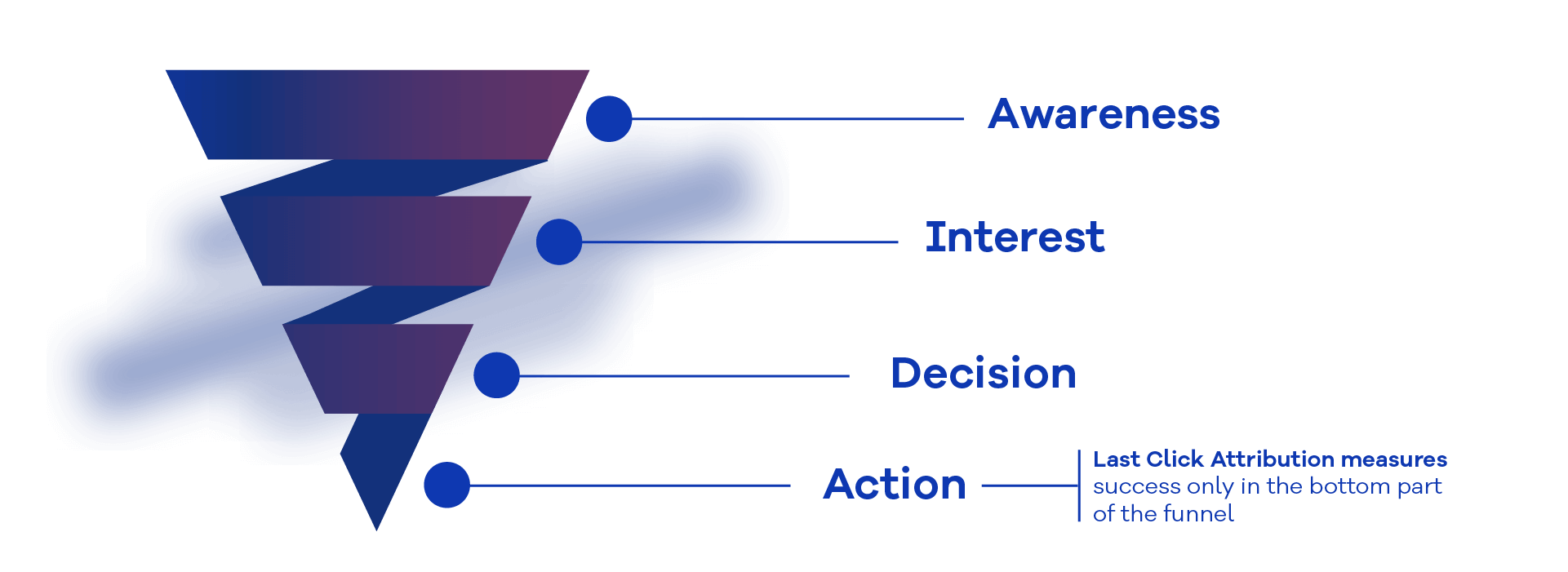
The distortion follows a predictable pattern, which is what makes it expensive:
- Brand search and retargeting look like heroes. They sit at the end of the path, so they collect credit for demand that other channels created.
- Upper-funnel keywords look like waste. Broad, early-stage terms rarely take the final click, so they show a high cost per conversion and become the first budget cut.
- Automated bidding learns the same bias. Smart bidding strategies such as Target CPA and Target ROAS optimize toward the conversions column, and the attribution model decides what that column contains. Under last click, the algorithm bids up the final step and bids down everything that leads to it.
The result is a funnel that narrows on its own. Each budget cycle shifts spend toward the channels last click rewards, and the channels that fill the pipeline lose funding without anyone deciding they should. The same pattern appears in healthcare marketing attribution, where branded search takes the credit for work that awareness and educational content did.
Last click vs. multi-touch attribution
Multi-touch attribution is the umbrella term for any model that spreads credit across more than one touchpoint. The classic rules-based versions each apply a fixed formula:
- First click gives all the credit to the first interaction, the mirror image of last click.
- Linear splits the credit equally across every touchpoint on the path.
- Time decay gives more credit to touchpoints closer to the conversion.
- Position-based gives 40% each to the first and last interactions and spreads the remaining 20% across the middle.
Data-driven attribution is also a multi-touch model, but it replaces the fixed formula with a model built from your own account data. It compares the paths of people who converted with the paths of people who didn’t, then gives more credit to the interactions that tend to come before a conversion. Each data-driven model is specific to the advertiser.
You’ll also see the term last-touch attribution. It describes the same idea as last click, and some platforms use it to include interactions that aren’t clicks, such as video views.
What Google changed in 2023
Rules-based models still exist in many analytics and attribution platforms, but not in Google’s. Google retired four attribution models in stages. From June 2023, new conversion actions in Google Ads could no longer select first click, linear, time decay or position-based. From September 2023, Google switched conversion actions still using them to data-driven attribution and removed them from reporting, including the Model comparison report. GA4 made the same change.
Google’s stated reason was low adoption. It reported that fewer than 3% of Google Ads web conversions were attributed with those four models. Advertisers who don’t want data-driven attribution can still choose last click.
That leaves a lot of older guidance unusable. Any article that recommends position-based or linear as the partner for smart bidding is describing settings that no longer exist in Google Ads or GA4.
Last click or data-driven?
With two models left, the comparison is narrow enough to set out side by side.
| Last click | Data-driven | |
|---|---|---|
| How credit is assigned | All of it goes to the final click | Shared across interactions, weighted by a model trained on your account’s conversion paths |
| Transparency | Fully transparent: anyone can audit the rule | Google publishes the methodology, but your account’s weighting isn’t exposed as a formula |
| Data needs | None | Works at any volume, though Google recommends at least 200 conversions and 2,000 ad interactions in 30 days for accuracy |
| Effect on automated bidding | Bids toward the final step of the journey | Bids toward the interactions that contribute across the path |
| Best fit | Short, single-session purchases and reporting that must reconcile with last-touch systems | Multi-step journeys across several campaigns, with enough conversion volume |
When last click still makes sense
Last click isn’t wrong everywhere. It’s a reasonable choice when journeys are genuinely short, such as a single search followed by a purchase. It also holds up when conversion volume is too low for data-driven to learn much, or when reports have to reconcile with a CRM or finance system that counts the last touch. Google notes that, depending on data availability, the two models can produce the same results.
The risk is keeping last click by default. If the journey involves research, comparison and several campaigns, which describes most enterprise purchases, last click will undervalue everything except the final step.
What data-driven trades away
Data-driven attribution fixes the credit problem by asking you to trust a model you can’t fully inspect. Teams that report to finance, procurement or a board should decide in advance how they’ll explain a shift in channel performance that came from the model rather than the market. Running the Model comparison report before switching gives you that baseline.
Does Google Analytics use last-click attribution?
Not by default. GA4’s default reporting attribution model is data-driven, and you can change it under Admin > Data display > Attribution settings. Two last-click options remain in GA4:
- Paid and organic last click ignores direct traffic and gives 100% of the credit to the last channel the user clicked through from. Google confirms this is the same model long known as last non-direct click.
- Google paid channels last click gives all the credit to the last Google Ads click and falls back to paid and organic last click when the path contains no Google Ads click.
Two details catch teams out. GA4 excludes direct visits from attribution credit unless the path consists entirely of direct visits. And reports built on session- or user-scoped dimensions, such as traffic acquisition, apply last non-direct click whatever the reporting model is set to. When GA4 and Google Ads disagree about a channel’s contribution, check which model each report uses before you question the data.
How to change the attribution model in Google Ads
Compare the two models before you switch. Google’s attribution models documentation covers the full setup. To compare models:
- Open the Goals menu and go to Attribution.
- Select Model comparison.
- Choose a dimension, such as campaign or keyword, and compare Last click with Data-driven.
The Cost / conv. and Conv. value / cost columns show which campaigns and keywords last click undervalues. To change the model for an existing conversion action:
- Open the Goals menu and go to Summary.
- Select the conversion action you want to change.
- Select Edit settings, then Attribution model, and choose the model from the drop-down menu.
- Select Save, then Done.
The model applies only to that conversion action, and it changes how conversions are counted from that point forward, not historically. Data-driven attribution in Google Ads is available to every conversion action, whatever its volume. If you use automated bidding, expect performance to move while the strategy recalibrates to the new conversion data, and review your bids and targets after the switch.
Where every click-based model goes blind
Choosing between last click and data-driven settles how credit is shared among the clicks you can see. Neither model can credit influence that never produces a click.
That gap is widening. When an AI assistant or an AI-generated search answer shapes a buyer’s shortlist, the buyer may never click an ad or a search result. If they arrive later by typing your URL, or through an AI answer link that doesn’t pass referrer data, the visit is recorded as direct, and GA4’s models exclude direct visits from credit. The conversion goes to whichever click came last, and the source that did the persuading never appears in the report.
This is a structural limit of click-based measurement, not something a model setting can fix. It’s why connecting answer engine visibility to outcomes depends on proxy measures that sit outside the conversion path. It’s also why click-based content measurement has a blind spot that no attribution model closes. Cross-device and cookieless journeys add to the gap, since any model can only credit the interactions it can connect to the same person. Rebuilding customer journey visibility on first-party signals recovers part of it.
Treat the attribution model as a governance decision
In a large organization, the attribution model is set per conversion action in Google Ads and separately in GA4. Different teams, agencies and accounts can end up on different models, and the reports they produce will disagree without anyone noticing why. A few practices keep that in check:
- Record which model each primary conversion action uses, and who owns that decision.
- Align the Google Ads and GA4 reporting models, or document why they differ.
- Run the Model comparison report before any switch, and keep the output as a baseline for explaining the change.
- Read every click-based metric as a partial view, alongside measures of search and AI visibility.
The same constraint runs through measuring SEO effectiveness. It shapes any attempt to measure the business impact of SEO, too. The attribution model decides which work looks valuable, so it deserves the same scrutiny as the budget it directs.